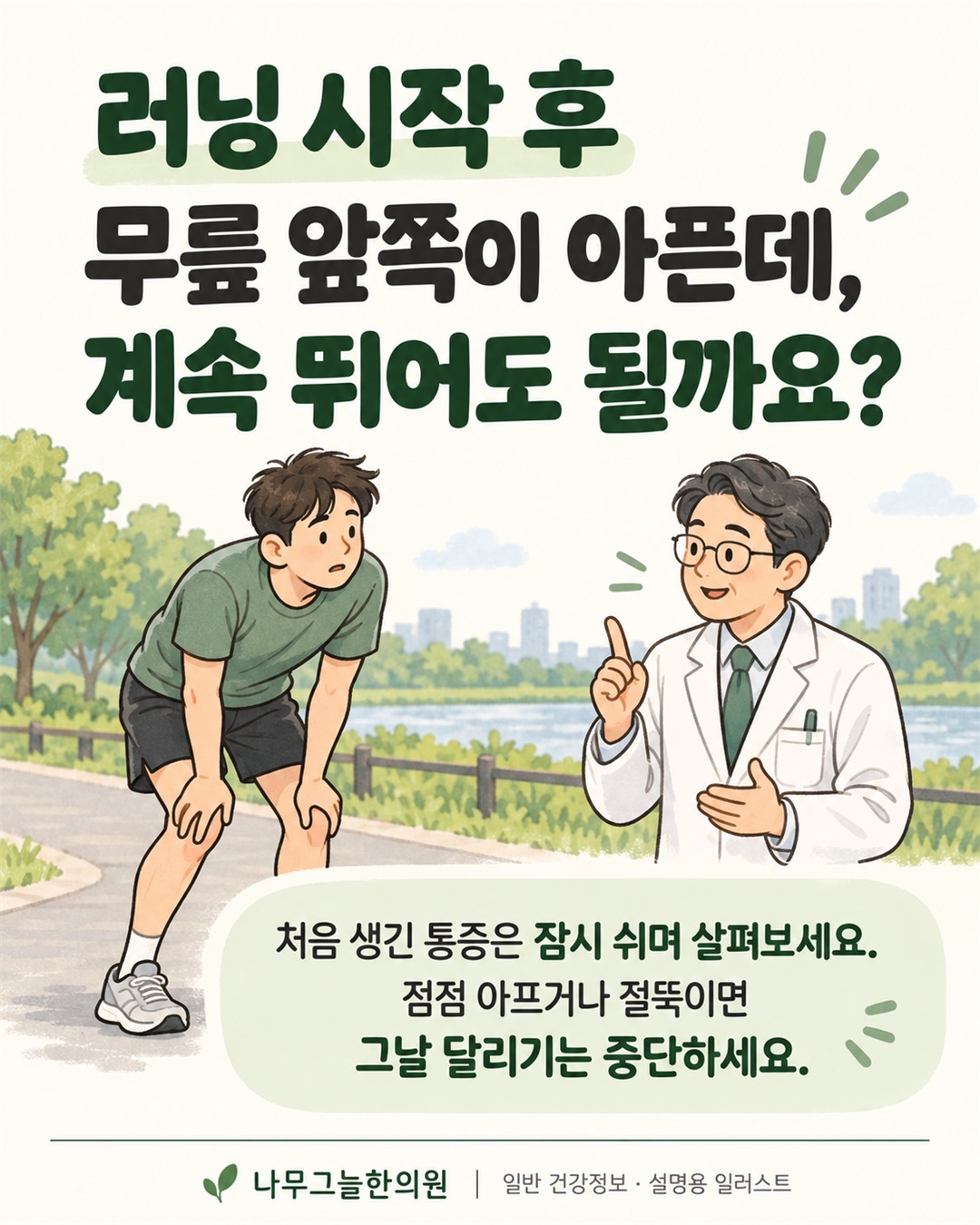
The front of my knee hurts after starting running. Can I keep running?
If the front of your knee begins to hurt after you take up running, pause running and observe how it responds. Stop that day's run if pain increases or you start limping. Pain around or behind the kneecap during stairs, squatting or running can occur with patellofemoral pain, but the location alone does not establish a diagnosis. New unexplained pain needs to be distinguished from an exercise plan prescribed after assessment.
Have you increased distance, frequency, speed or hill sessions, or returned abruptly to your former workload after a break? These changes do not prove the cause. Record running time, symptoms before and after activity, and your response to walking or stairs the next day.
The front of my knee hurts after starting running. Can I keep running?
02
After assessment, check three points in time.
If patellofemoral pain has been assessed, exercise within your individual advice and monitor symptoms during exercise, afterwards and the next day. Reduce duration or intensity and adjust the plan if pain rises during exercise, discomfort persists at rest afterwards, or walking and stairs are harder the next day. This does not mean running through new unexplained pain.
03
Choose other activity and strengthening to suit your condition.
Walking or swimming may help you remain active if they do not increase symptoms. Reduce those activities too if they aggravate pain. Education and knee-focused strengthening are central to assessed patellofemoral pain; hip exercises may be added according to individual assessment. Get advice on the type, range and amount of exercise. One exercise is not suitable for every cause of front-of-knee pain.
The 2024 best-practice guide for patellofemoral pain recommends knee-targeted exercise underpinned by education, with hip exercise and other interventions selected according to individual needs. This is not advice to use one exercise for every cause of anterior knee pain.
04
What treatment is considered at the clinic?
At Namugeuneul Korean Medicine Clinic, we review when pain began, changes in training load and discomfort during movement before considering treatment appropriate to the person's condition. Acupuncture, Chuna, bee venom acupuncture or herbal medicine may be planned alongside activity adjustment.
05
Acupuncture
Acupuncture may be considered to help control pain. In a study of 75 people with patellofemoral pain, the group receiving acupuncture for 4 weeks had higher knee scores assessing pain and activity function at 1 year than the group receiving no treatment. Studies included in a 2023 systematic review also reported reductions in pain and improvements in knee function before and after acupuncture. Treatment is planned alongside exercise, education and load management according to examination findings and response.
06
Chuna and related manual-therapy research
We assess movement of the lower back, pelvis and hip as well as the knee when planning treatment. In a 2025 study of 30 people with patellofemoral pain, 4 weeks of lumbar manipulation improved pressure pain threshold and quadriceps strength compared with a sham intervention. A higher pressure pain threshold means that more pressure can be tolerated before it becomes painful.
In another study of 60 people with chondromalacia patellae, Chinese spinal manipulation combined with quadriceps rehabilitation resulted in lower pain scores and higher knee-function scores after 4 weeks than medication treatment.
07
Bee venom acupuncture
Whether bee venom acupuncture is appropriate depends on the diagnosis and individual condition. A 2025 review of bee venom acupuncture for musculoskeletal pain included 20 clinical trials. Among them, research on knee osteoarthritis reported a greater reduction in pain with bee venom acupuncture than with the comparison injection. Anterior knee pain after running requires examination to identify its cause and choose treatment. Bee venom acupuncture can cause bee venom allergy and anaphylaxis; allergy history and previous treatment reactions must be reviewed, and treatment is performed under clinical judgment.
08
Herbal medicine
The decision to prescribe herbal medicine takes account of knee symptoms, overall health, current medicines and underlying conditions. Prescriptions are tailored to symptoms and difficulties in daily life. Relevant literature includes a review of research trends on treatment involving herbal decoctions for chondromalacia patellae.
09
Return gradually.
Once daily movements and walking feel comfortable, try alternating walking with short runs on level ground and observe the response. Do not increase duration, speed and frequency together. Persistent or recurrent pain needs assessment. A fixed recovery deadline or increase rate does not apply to everyone.
10
Seek care promptly
for major swelling, inability to put weight through the knee, locking or giving way. Redness and warmth together with fever require same-day care. Persistent, recurrent or worsening pain calls for assessment and an individual activity plan.
11
Visiting and booking at Namugeuneul Clinic
Before visiting, check temporary closures and whether same-day registration is available. This article provides general health information and does not replace individual medical care.
Hours: Monday–Friday 09:00–20:00; lunch 13:00–14:00. Saturday 09:00–14:00, without a lunch break. Closed Sundays and public holidays.
Phone: 031-674-1075. Booking and inquiries: Naver Booking and KakaoTalk.
The building's mechanical parking is available for passenger cars of 2,000 cc or less, but access may be difficult after 17:00. If building parking is unavailable or the car exceeds 2,000 cc, use Seokjeong-dong Public Parking, 7 Jungang-ro 367beon-gil, Anseong-si. Up to 90 minutes of free parking is supported.