
Namugeuneul

Pain after a traffic accident: what does the clinic assess?

After a traffic accident, treatment is guided by how symptoms change, where pain occurs and which movements are difficult. Along with the neck and lower back, the shoulders, knees, ankles and wrists are also assessed.

View Korean original
01

Notice painful movements and symptom changes

Symptoms may become clearer after initially being tolerable. The size of the accident alone does not determine the body's condition. Tell the clinician when pain began, whether the arms or legs feel numb, and whether turning or bending the neck, sitting or standing up is uncomfortable. Also mention pain when raising an arm, bending a knee, using stairs, walking or holding objects. There is no need to repeatedly push a painful joint to its limit.
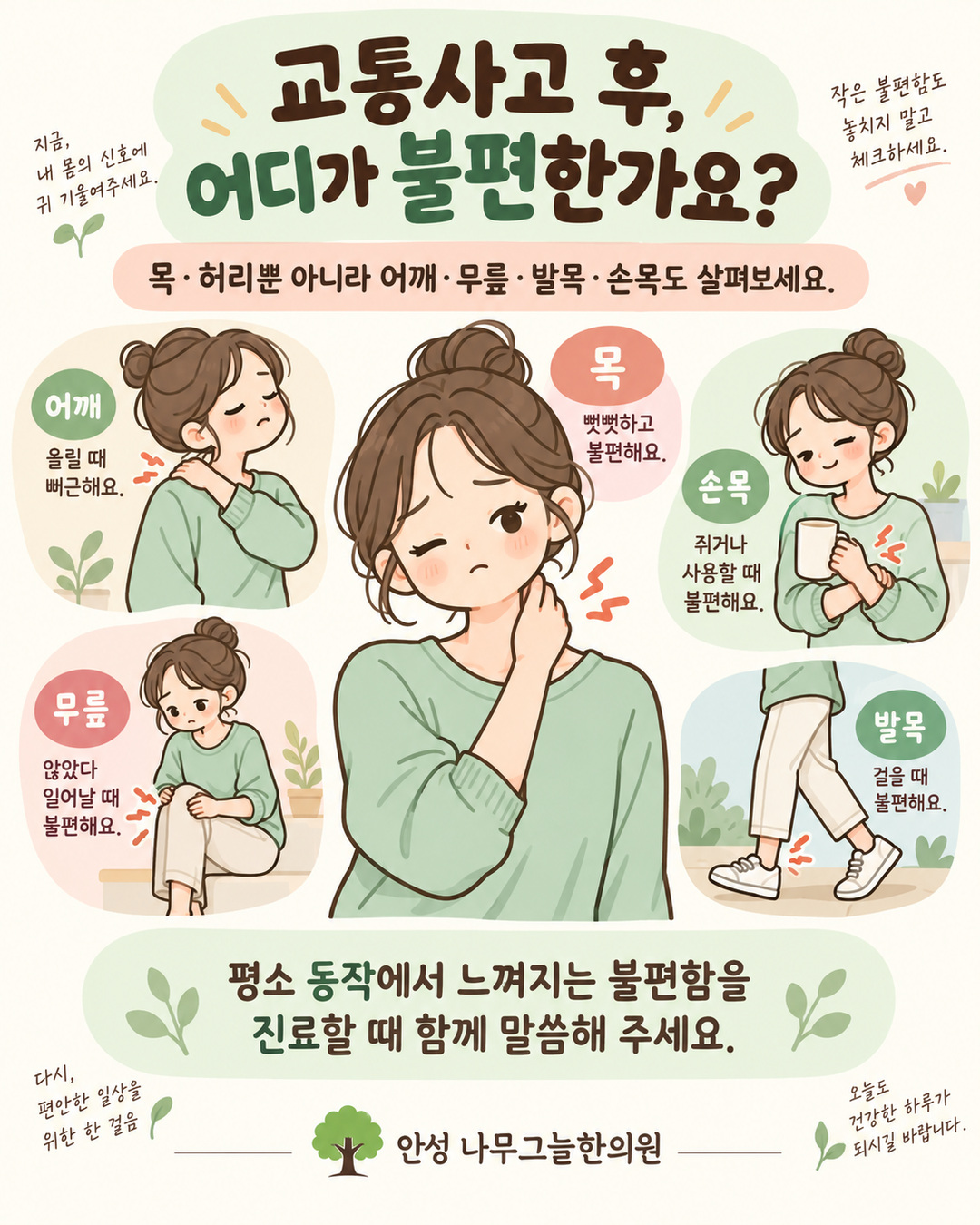
Cute adult cartoons showing uncomfortable neck, shoulder, knee, ankle and wrist movements after a traffic accident.
The illustration contains Korean text. This article provides the information in English.
02

Adjust daily activity

Once fractures and serious injuries have been excluded, and unless you have been advised to rest, continue light daily activity within comfortable limits. Break up long periods of sitting and reduce heavy lifting and sudden twisting. Avoid forceful stretching or cracking your own neck. Adjust activities that strain the shoulders, knees, ankles or wrists. If movement clearly worsens pain or numbness, seek reassessment.

03

Assessment of pain and movement

The clinician discusses the accident and symptom changes and assesses movement, tenderness, sensation and strength in the arms and legs. Pre-existing symptoms are considered. Neck, lower-back and limb function guide the choice of treatment and whether further assessment is needed.

04

Namugeuneul provides the best care needed by each patient

Carefully assessing pain location, severity and restricted movement, the clinic selects necessary treatments such as acupuncture and Chuna. Chuna is applied after assessing spinal and joint movement and surrounding muscle tension. In a randomized trial of 132 patients with neck pain more than 2 and less than 13 weeks after traffic accidents, adding Chuna to usual care produced better improvements in pain and function. During care, pain and everyday movements such as turning the head, sitting and walking are reviewed to adjust treatment and self-care.

05

Seek prompt assessment for these changes

Seek appropriate medical assessment without delay for new limb weakness, worsening sensory changes, difficulty walking or changes in bladder or bowel control. Severe headache with repeated vomiting or altered consciousness requires emergency assessment.

06

Visit Namugeuneul Korean Medicine Clinic

Please feel free to visit if you have discomfort after an accident. We assess neck, lower-back, shoulder, knee, ankle and wrist pain. Address: Room 304, 3rd floor, Hapyeong Place, 370 Jungang-ro, Anseong. Phone: 031-674-1075. Monday–Friday 09:00–20:00, lunch 13:00–14:00. Saturday 09:00–14:00 without a lunch break. Closed Sundays and public holidays. Call before a late visit to confirm reception availability. This article provides general medical information; individual diagnosis and treatment are determined through examination.

Open until 8 p.m. on weekdays

하평플리스, 3rd floor, room 304, 370 Jungang-ro, Anseong-si, Gyeonggi-do
Mon–Fri 09:00–20:00 · Lunch 13:00–14:00 · Sat 09:00–14:00