Kyungokgo and Gongjindan are herbal medicines that have long been used when people feel tired and have low energy.
Although both are commonly called ‘restorative medicine’, the medicinal ingredients used are different, and there are differences in the content of research so far. So, rather than saying that one is unconditionally better, it is better to choose one based on your current fatigue and lifestyle.
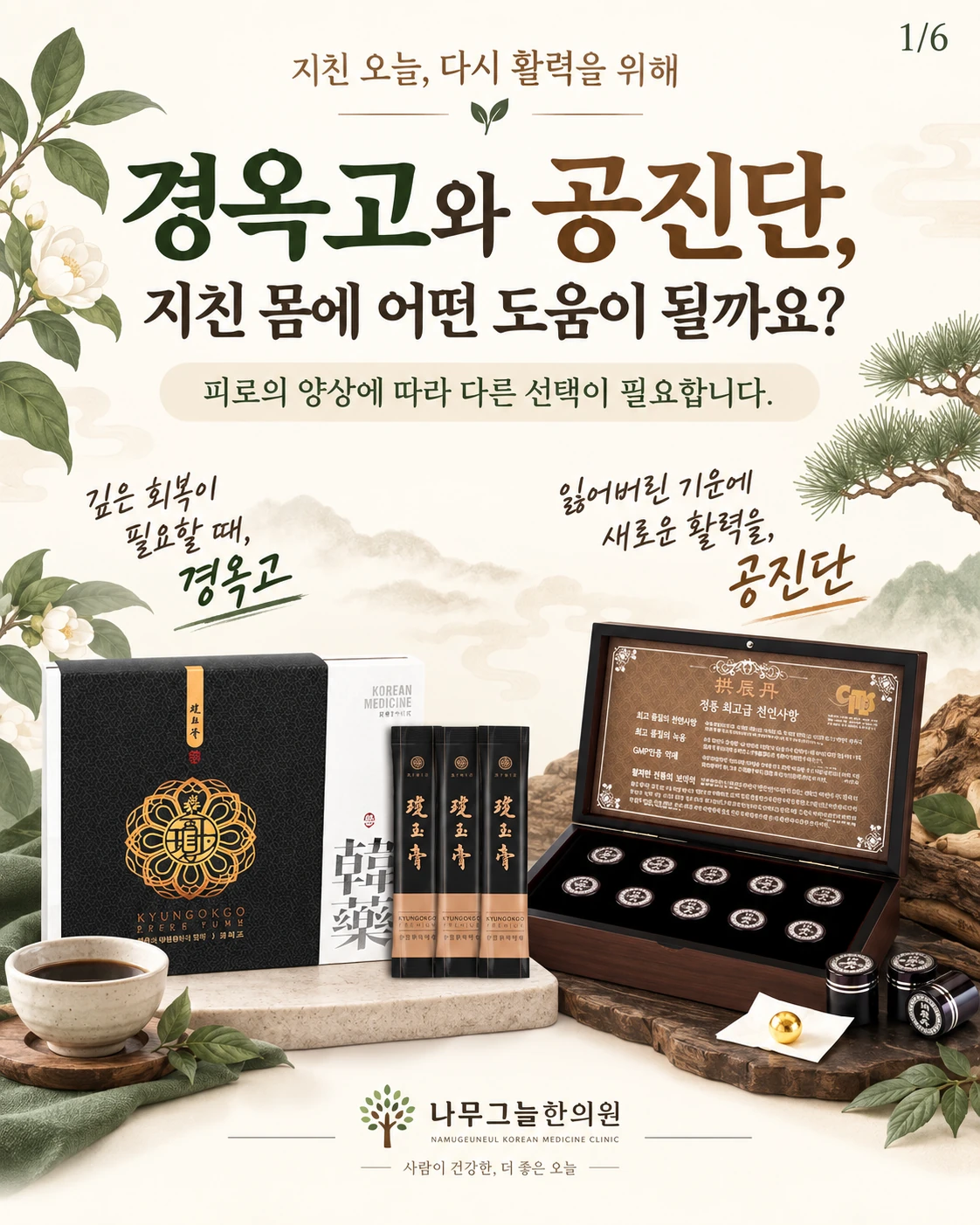
Dosage forms have become more varied. Kyungokgo is available in traditional jars and individually packaged single-dose sticks. Gongjindan also differs in composition: the original formula contains musk, while Mokhyang Gongjindan uses costus root (Aucklandia lappa).
Let's take a look at what medicinal ingredients are used in Kyungokgo and Gongjindan and what research has been done on them regarding fatigue.
This is the original Korean guidance image. Please check the translated text of this page for details.
02
What kind of drug is Kyungokgo?
Kyungokgo is based on fresh rehmannia root, ginseng, poria and honey.
The ingredients are prepared as a thick paste. Traditionally, it has been used as a tonic when people feel tired and low in energy.[3]
There is also a recent study looking at Kyungokgo and fatigue and post-exercise recovery.
In a 4-week study conducted on 24 high school soccer players in 2011, the group taking Kyungokgo showed higher maximal oxygen intake than the placebo group, and lower heart rate during the post-exercise recovery period.[7]
Maximum oxygen intake is an indicator of how well our body can use oxygen when exercising.
However, because it is a small-scale study targeting athletes, it is difficult to interpret these results as applying them to general fatigue.
In 2026, a study was also published that looked at Kyungokgo in 100 people who had continued fatigue after Long Covid. After 12 weeks, a tendency for fatigue scores and sleep conditions to improve was observed.[3]
03
In this case, you may consider Kyungokgo
If you find that fatigue does not go away easily after being active, or if it takes a long time to return to your previous condition after suffering from an infection or illness, you may want to consider Kyungokgo.
However, just because you are tired does not necessarily mean you should take supplements first.
It is also necessary to check whether you are getting enough sleep, whether you are eating well, how your digestion is, and whether there have been any recent changes in your lifestyle or weight.
If severe fatigue persists for a long time without any reason, you may need to check for other causes such as anemia, thyroid disease, or sleep disorders.
It is a good idea to first look at your current physical condition and decide whether Kyungokgo is appropriate or whether other prescriptions are needed.
04
What kind of medicine is Gongjindan?
The original Gongjindan formula generally contains deer antler velvet, danggui (Angelica root), sansuyu (Cornus fruit) and musk, formed into pills with honey.[5]
Gongjindan also has some clinical studies related to fatigue.
In 2018, there was a study in which 23 healthy men restricted their sleep time and then took Gongjindan. Improvements were observed in some sleep-related items compared to the placebo group, and in the first stage of analysis, differences were also found in fatigue scores.[1]
In 2024, a study was published comparing 90 adults with chronic fatigue divided into the Gongjindan group, Ssanghwatang group, and placebo group.
Among various quality of life evaluation items, the ‘social function’ item in the Gongjindan group improved after 4 weeks compared to the placebo group.[2,6]
Here, social functioning is an item that evaluates the extent to which health problems affect the ability to meet people or engage in daily social life.
Because these studies did not have a large number of participants and were conducted under specific conditions, it does not mean that everyone will see the same changes when taking Gongjindan.
05
In this case, you may consider Gongjindan
If you get tired easily due to a sleep-deprived lifestyle, or if fatigue persists for a long time and you feel burdened in your daily life, you may want to consider Gongjindan.
However, Gongjindan is not chosen based on the symptom of ‘being tired’ alone.
It is a good idea to check how much you sleep, how your meals and digestion are, whether you have recently been overworked or stressed, and whether you are currently taking any medications or have any existing diseases.
Since the cause of fatigue varies from person to person, the necessary medication composition and dosage method are determined after checking the current condition.
06
Kyungokgo, what is the difference between jar type and stick type?
Kyungokgo has traditionally been taken by putting it in a jar and taking as much as needed with a spoon.
There is some familiarity with the jar-type Kyungokgo, but there are some inconveniences when actually taking it.
Since you use a spoon each time, the amount you eat at one time may vary slightly, and you should also be careful to prepare a clean and dry spoon each time you use it. Care must be taken in storage management, such as not putting saliva or wet spoons back into the container.
Stick type Kyungokgo makes this part simple.
Each single dose is individually packaged, so you do not need to scoop it out each time. This makes it easier to take a consistent amount without a separate spoon.
Another advantage is that you can put as much as you need in your bag and take it with you when you go to work, travel, or go out.
Therefore, if you mainly take it at home and prefer the traditional method, the jar form is fine, but if you take a consistent dose or value portability, the stick form may be more convenient.
Recently, Kyungokgo in stick form is also widely used due to its convenience.
07
Musk, a herbal medicine often discussed in Gongjindan
When looking at Gongjindan, the medicinal ingredient that is difficult to miss is musk.
Musk is a main ingredient of the original Gongjindan formula, together with deer antler velvet, Angelica root and Cornus fruit.
In Korean medicine, it has been used for the purpose of clearing the mind and communicating the flow of blocked energy and blood, and is traditionally explained with terms such as ‘Gaegyuseongshin’ and ‘Hwalhyeol’.[5,11]
When choosing Gongjindan, it is better to check what medicinal ingredients are actually contained rather than simply looking at the name ‘Gongjindan’.
This is because even if the same name Gongjindan is used, the composition and content are not all the same.
In particular, check whether it is original Gongjindan containing musk, or Mokhyang Gongjindan, which uses costus root instead of musk.[9,10]
The two prescriptions have similar names but different medicinal compositions.
When choosing Wonbang Gongjindan, it is recommended not only to check whether musk is contained, but also to check how much musk is contained in one pill.
08
In the end, what matters is the state of my body.
It is difficult to simply compare which is better between Kyungokgo and Gongjindan.
This is because the appearance of fatigue varies from person to person.
Some people are constantly tired because they cannot sleep properly, and some people have slow recovery after suffering from an infection or serious illness. In some cases, you may feel low energy due to not eating properly or due to poor digestion, and in other cases, fatigue may accumulate due to overwork or prolonged stress.
So, when choosing a tonic, it is important to first look at these differences.
We check your sleeping, eating, and digestion status, and also look at any medications you are currently taking or any existing diseases.
It is recommended that you inform us in advance if you are pregnant, breastfeeding, or allergic to certain medications.[4]
There is one thing to note when looking at the research results introduced in this article.
The studies introduced are the results of specific agents used in each study.
All commercially sold or clinic-prescribed Kyungokgo and Gongjindan products do not have identical ingredients and amounts. Results from one specific preparation cannot be applied to every product.
In the end, whether it is Kyungokgo or Gongjindan, it is important to look at the actual composition and content of the medicine as well as your current physical condition rather than just looking at the name.
※ This article is intended to provide general medical information about Kyungokgo and Gongjindan. Prescription and dosage depending on the individual's condition are determined through medical treatment.
09
reference material
8. Okchundang Appointment Prescription Kyungokgo Stick A product detailed data, confirmed on 2026-09-17.