
Namugeuneul

Plantar fasciitis: heel pain on the first morning steps

A sharp heel pain when you first get out of bed, easing after a few steps, is common in plantar fasciitis. Heel pain has several causes, so the painful location and changes after activity also matter.

View Korean original
01

Why do the first steps hurt?

The plantar fascia runs from the heel toward the toes and supports the arch. Repeated loading during walking and running can lead to pain near the heel. Symptoms often stand out after sleep or a long period of sitting. Pain may ease with movement and return after prolonged walking or standing. Consider recent changes in exercise and time spent standing.
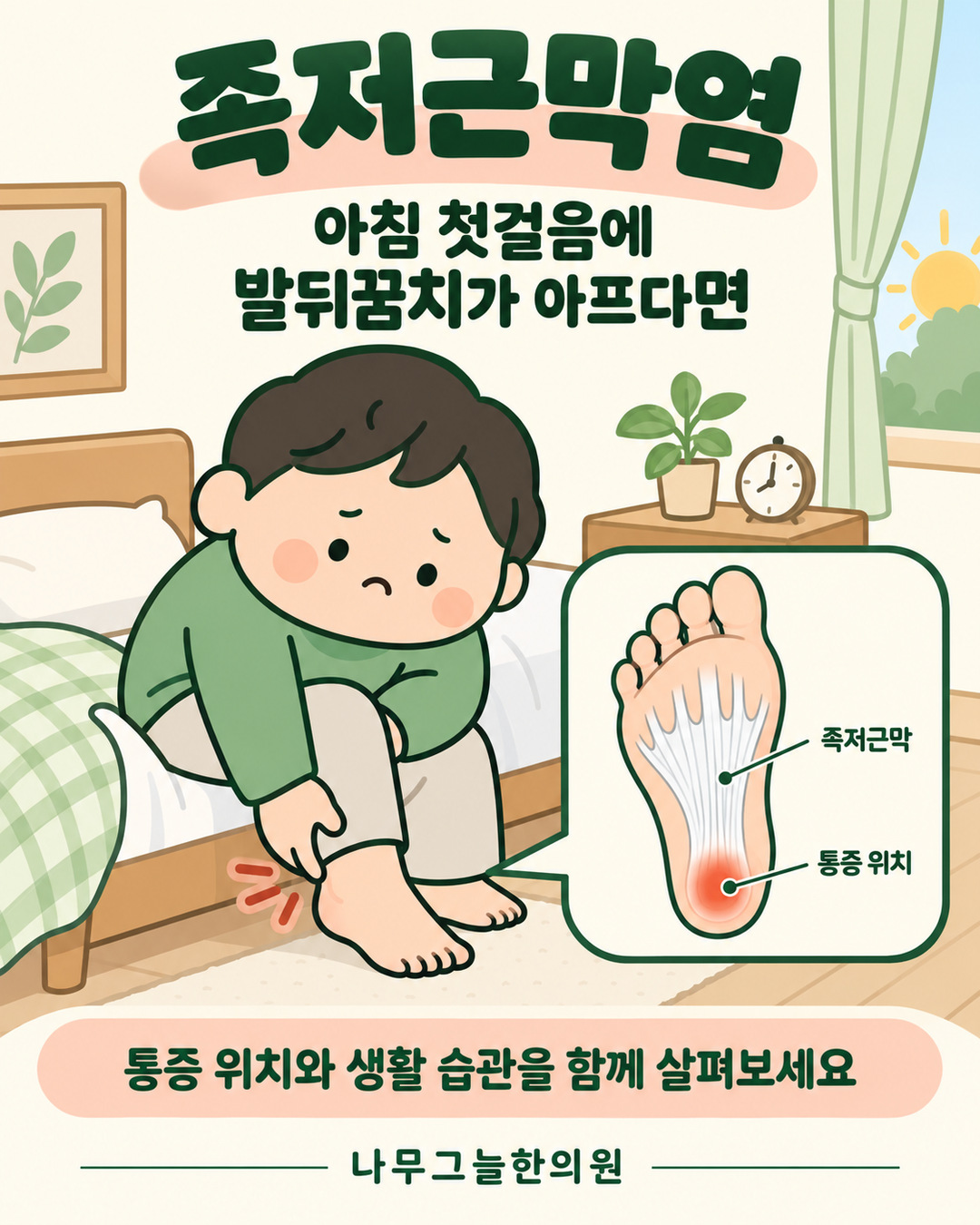
A cute cartoon of a patient with heel pain on the first morning step and a Korean medicine doctor explaining plantar fasciitis.
The illustration contains Korean text. The article below provides the English information.
02

Start with daily load and footwear

If running or long walks make pain worse, reduce their distance and duration and choose comfortable activities. Replace shoes with worn heel cushioning or poor support, and reduce prolonged barefoot walking on hard floors. Gently stretch the sole and calf. While sitting, slowly draw the toes toward you until you feel a light stretch in the sole. Stop with sharp pain and avoid pressing hard on the painful area.

03

Acupuncture and Chuna

Acupuncture is used to reduce plantar fasciitis pain alongside activity adjustment and exercise. A review of acupuncture studies reported reduced pain. Chuna assesses ankle movement and tension in the sole and calf, working with restricted movement and tense tissues. A 2024 review of 10 manual-therapy studies reported improvements in pain and lower-limb function. It combined several manual therapies and informs the clinical direction of Chuna care.

04

Bee venom acupuncture and herbal medicine

Namugeuneul Korean Medicine Clinic uses bee venom acupuncture in plantar fasciitis care. The clinician assesses pain location, tenderness and walking discomfort to determine the treatment site and dose, together with acupuncture, Chuna and self-care. Herbal prescriptions consider pain patterns, accompanying symptoms, overall health and current medicines. In a Korean report combining oral herbal medicine with acupuncture, moxibustion and physiotherapy, pain decreased in 3 of 4 cases.

05

When to seek prompt assessment

Seek assessment if you cannot bear weight after an injury, swelling and warmth are marked, pain worsens at rest, or numbness or reduced sensation occurs. Heel-fat-pad problems, bone stress injury and nerve irritation can cause similar symptoms; plantar fasciitis is not diagnosed from symptoms alone.

06

Clinic hours, location and parking

Monday–Friday 09:00–20:00; lunch 13:00–14:00. Saturday 09:00–14:00 with no lunch break. Closed Sundays and public holidays. Call before a late visit to confirm reception. Address: Room 304, 3rd floor, Hapyeong Place, 370 Jungang-ro, Anseong-si, Gyeonggi-do. Telephone: 031-674-1075 / 031-674-1076. Building mechanical parking accommodates passenger cars of 2,000 cc or less; availability may be limited after 17:00. Larger vehicles or unavailable building parking: Seokjeong-dong public car park, 7 Jungang-ro 367beon-gil, Anseong-si. Up to 90 minutes of free parking is supported.

Open until 8 p.m. on weekdays

하평플리스, 3rd floor, room 304, 370 Jungang-ro, Anseong-si, Gyeonggi-do
Mon–Fri 09:00–20:00 · Lunch 13:00–14:00 · Sat 09:00–14:00