Woke up unable to turn your neck—is it just a stiff neck?
The Korean expression ‘dam’ describes a painful, stiff feeling; it is not a precise diagnosis. Muscles and joints around the neck may be involved, but numbness or weakness in the arm or hand also needs attention. For relatively mild pain without injury or warning signs, try slow, gentle movement within a tolerable range rather than holding the neck completely still. Do not force it to release by hard massage or twisting.
You may go to bed feeling well, then wake with pulling pain at the back of the neck or top of the shoulder. Even a small movement may hurt. Acute torticollis describes a sudden tilted or turned position of the head with painful movement. Stiffness alone does not establish this or any other diagnosis.
It is not necessarily caused by a badly positioned pillow. Prolonged posture the previous day, more neck use than usual, accumulated muscle and joint fatigue, and holding one position during sleep can contribute together. Rather than blaming one cause, note which direction is difficult and what other symptoms accompany the pain.
02
Is the pain confined to the neck?
Stiffness and pain in a particular direction are common in acute neck pain. Turning right may pull on the left side; bending forward or looking up may hurt at one spot; tightness may extend to the top of the shoulder.
Check both where it hurts and how much movement is limited. If symptoms reach the arm or hand, or sensation and strength have changed, nerve function should also be assessed rather than assuming it is only muscle tightness.
03
Gentle movement can help, even with slight discomfort
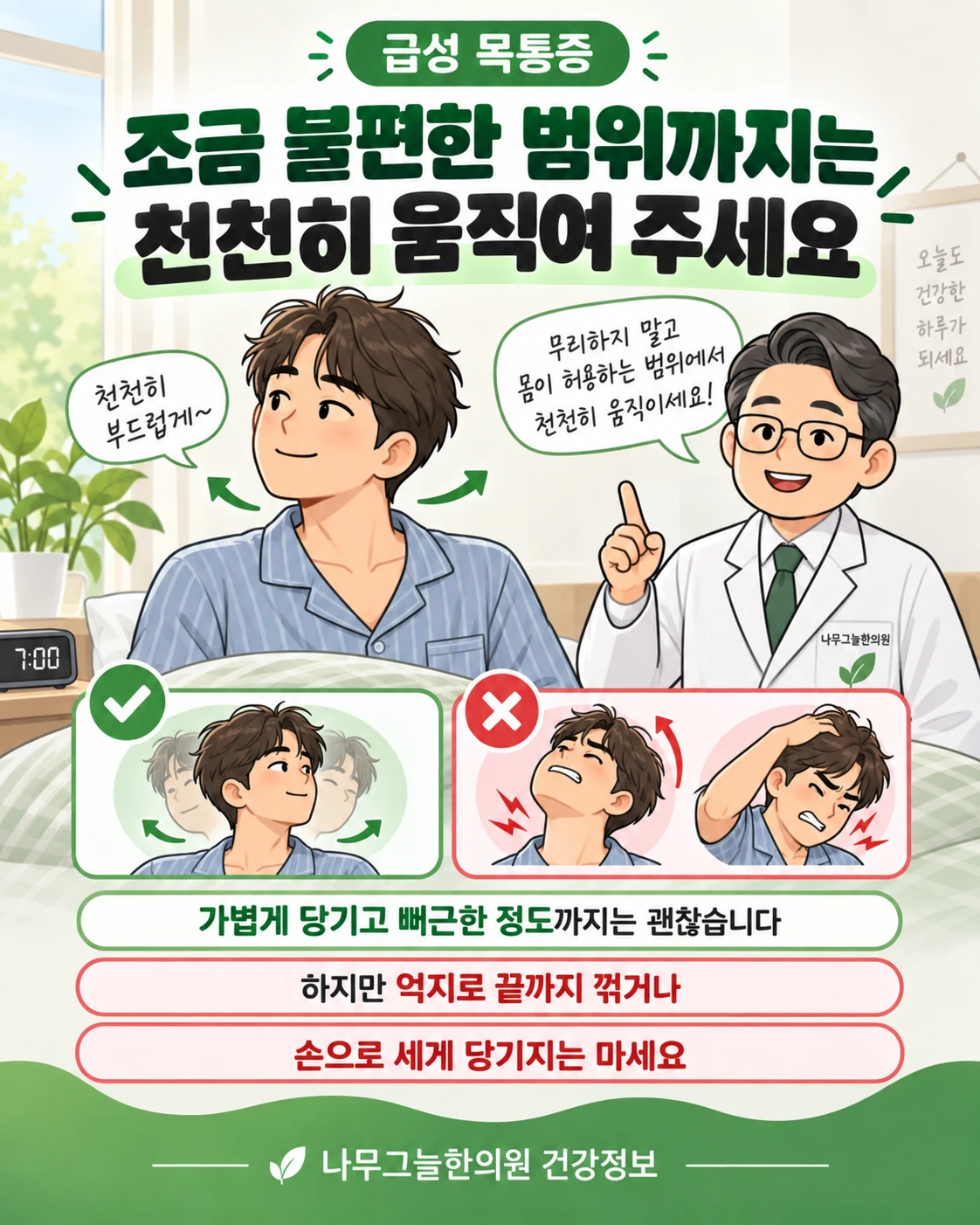
For relatively mild acute neck pain without trauma or the warning signs below, gradual movement within tolerable limits is generally preferable to complete immobilization. You do not necessarily need to stay within a range that is entirely free of discomfort.
A mild pulling sensation or slight discomfort can be acceptable while you slowly increase movement. Try turning gently to either side, lowering the head a little and returning to neutral, or moving the shoulders lightly.
Gentle movement with slight discomfort is different from forcing through pain. Stop the provoking movement if pain increases rapidly or spreads with tingling into the arm or hand. New weakness calls for medical assessment before continuing exercises.
Do not pull the head hard with your hands.
Do not turn to the limit through sharp pain.
Do not repeatedly twist the neck to make it crack.
Notice whether pain or numbness worsens after moving.
Original Korean illustration: move slowly within a tolerable range. Do not push through sharp pain, force the neck to its limit, or pull hard with your hands.
04
What if my arm or hand is numb?
Irritation of a nerve in the neck can cause pain or tingling that extends beyond the neck and shoulder into the arm and hand. Reduced finger sensation or a weaker grip also matters.
These symptoms alone do not prove a cervical disc herniation. However, new arm or hand weakness should prompt a neurological assessment rather than repeated attempts to ‘loosen’ the neck.
05
Be careful about driving
Changing lanes and checking traffic at intersections require adequate visibility to both sides. If you cannot move your neck enough to look around safely, avoid driving until pain settles and movement recovers.
06
What do we assess at the clinic?
At Namugeuneul Korean Medicine Clinic, treatment is not chosen solely from the description ‘a stiff neck’. We first assess onset, movement and accompanying symptoms.
Acupuncture, cupping or Chuna therapy may be selected and their intensity adjusted to the findings. Not every restricted neck should be moved or manipulated in the same way. Severe acute pain or possible nerve involvement requires distinguishing the current condition first; further tests or assessment by another service may take priority.
When symptoms started and which movements hurt
How much neck movement is limited
Whether symptoms stay in the neck or reach the arm or hand
Many episodes of acute neck pain gradually improve with time. There is no need to assume the worst, but neither should you assume that forceful treatment will solve it.
Note the difficult direction, whether gentle movement is possible, and any arm or hand tingling or weakness. Seek care if pain does not improve after a few days or continues to disrupt sleep and daily activities. When warning signs are present, assessment matters more than trying to release the stiffness.
08
When should I seek medical assessment?
The following need evaluation. Seek emergency care without delay for severe neck pain after major trauma, sudden marked weakness or altered walking, an unusual severe headache, or severe neck pain with fever.
Neck pain after a traffic accident, fall or other injury
Marked loss of sensation or weakness in an arm or hand
The following article discusses lumbar disc herniation and choosing treatment according to neurological findings. It is not a guide to diagnosing a neck disc problem.
This article is adapted from the Korean original and does not replace individual diagnosis or treatment. Severe symptoms, weakness, altered sensation, injury or fever require assessment by a healthcare professional.