I was told my disc has ruptured. Can I receive Chuna therapy?
A ruptured disc does not automatically mean you should avoid Chuna therapy. If there are no serious neurological abnormalities, active conservative care can be considered, and Chuna can be a worthwhile treatment option.
A rapid loss of leg strength or a change in bladder or bowel control calls for prompt medical assessment before Chuna. Treatment is not determined by the size of a herniation on MRI alone: spontaneous resorption, pain, sensation, strength and daily movement must be considered together.
02
What does “disc” actually mean?
The condition commonly called a “slipped disc” in the lower back is lumbar disc herniation. A disc is an anatomical structure between the vertebrae, rather than the name of a disease. It absorbs shock and helps the spine move.
Herniation means that some disc tissue protrudes or escapes backwards or sideways beyond its usual position. The whole disc does not fall out. Part of the tissue, including material from the inner nucleus pulposus, passes through a damaged area of the outer annulus fibrosus.
If that tissue irritates or compresses a nerve, pain or numbness may extend from the lower back through the buttock, thigh, calf and foot. Sensation and muscle strength can also be affected.
03
What does a “ruptured disc” describe?
MRI findings distinguish bulging, protrusion, extrusion and sequestration. “Rupture” is sometimes used to explain an extrusion, where tissue extends further out, or sequestration, where a fragment has separated from the original disc.
This does not by itself mean that the condition is too severe for conservative care. Several studies have reported spontaneous reduction even in more extensively herniated tissue.
04
Can a large herniation shrink naturally?
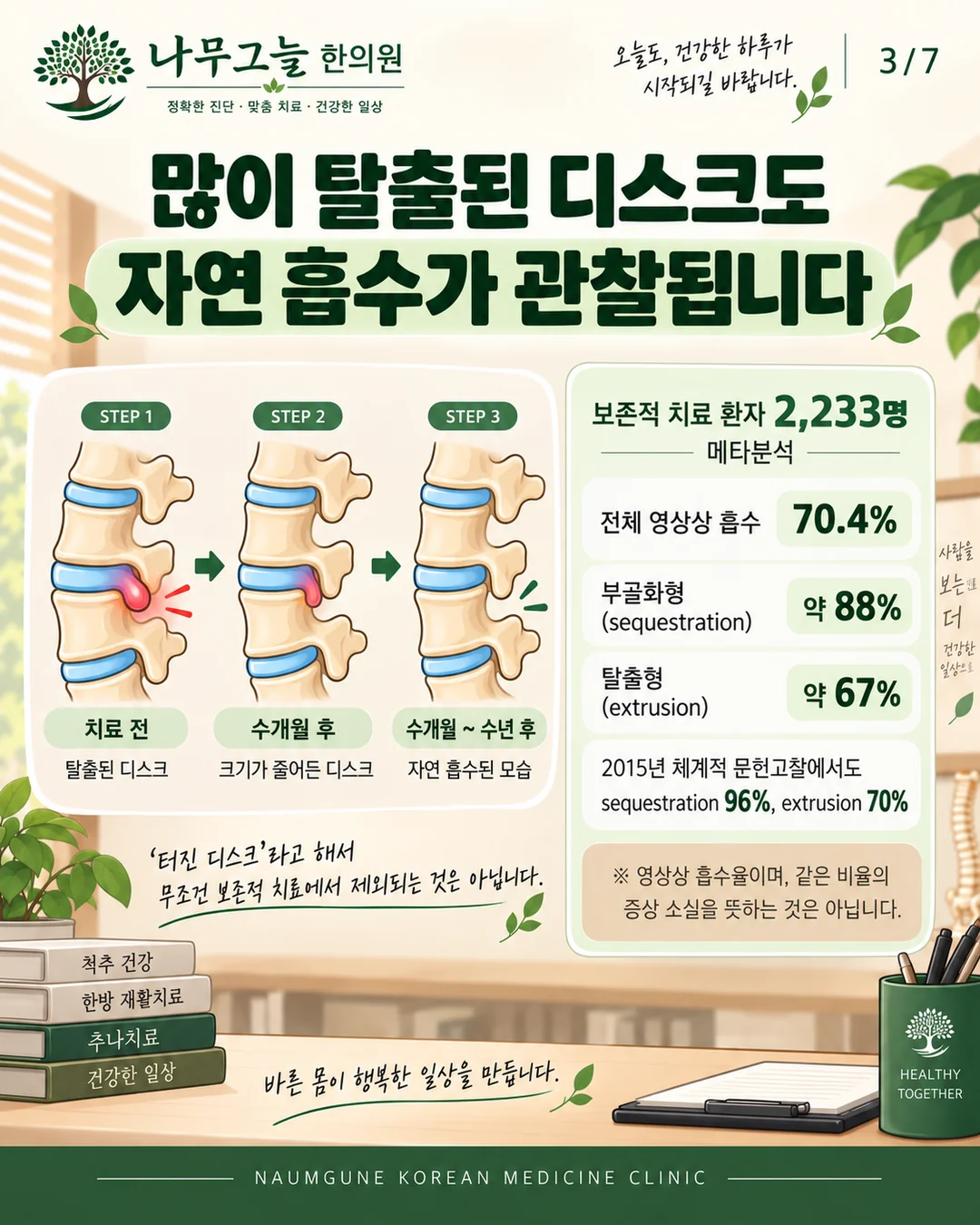
A meta-analysis of 31 studies including 2,233 patients receiving conservative care found imaging evidence of resorption in about 70.4% overall. Rates were approximately 88% for sequestration and 67% for extrusion. Resorption was mainly observed within the first 6 months of conservative treatment.
A 2015 systematic review also reported spontaneous regression or resorption in 96% of sequestrations and 70% of extrusions. Estimates vary between studies, but the tendency towards frequent regression in these more displaced forms is similar.
These figures describe a reduction in herniated tissue on MRI or other imaging. They do not mean that pain or numbness completely disappeared in the same proportion of patients, and they are not success rates for Chuna itself.
A large or ruptured disc therefore does not automatically require surgery or rule out a treatment involving movement. Imaging changes and symptoms do not always follow the same course, so the current clinical condition matters.
Original Korean illustration. Herniated tissue can shrink naturally; imaging resorption rates do not predict complete symptom relief or an individual's recovery time.
05
Does Chuna push the disc back into place?
Chuna does not physically push herniated disc tissue back into place. Resorption is a biological recovery process within the body.
Chuna is a form of conservative care used to help reduce pain and restore movement and everyday function after assessing pain patterns, lumbar and pelvic movement, function and neurological symptoms.
The Korean medicine clinical practice guideline for lumbar disc herniation describes acupuncture, pharmacopuncture, Chuna and cupping as options that may be used alone or together according to severity. Clinical symptoms and imaging findings should be assessed together. A large MRI finding is not a reason to use force to “put the disc back”.
In clinical practice, some people with a large herniation manage everyday activities relatively well, while others with a smaller finding are troubled by leg pain and numbness. An MRI image alone is therefore not enough when considering Chuna.
If a nerve root is affected, preserved strength and sensation are important alongside pain intensity. Assessment includes:
Positions that worsen lower-back pain
Pain or numbness extending from the buttock into the leg
Areas of reduced sensation
Weakness in the leg or foot
Changes during walking, sitting and standing
07
Does a larger herniation need stronger Chuna?
A larger herniation does not mean stronger treatment is needed. Chuna is not a single technique that forcefully twists the back to produce a cracking sound.
The method and intensity may vary with pain severity, the acute or chronic stage, leg symptoms, lumbar movement, age and other spinal conditions. When pain and muscle tension are marked in the acute stage, gentler methods within a tolerable range may be selected.
If there are no serious neurological abnormalities, Chuna can be a worthwhile conservative option. What matters is which method suits the current condition, rather than how much force is used.
08
Which changes need urgent medical assessment?
Not every lumbar disc herniation can be managed with conservative care alone. Changes in strength, sensation, bladder or bowel function can indicate severe nerve compression. Seek prompt medical evaluation rather than waiting for the next treatment appointment or deciding about Chuna first.
Sudden marked or progressively worsening leg weakness
Difficulty lifting the ankle or toes, suggesting foot drop
Reduced sensation around the perineum or anus
Difficulty passing urine or sudden changes in bladder or bowel control
09
Related information
For related questions about activity, numbness and clinical assessment, read the following pages.
This is general medical information adapted from the supplied Korean article. It does not replace an individual diagnosis. Treatment methods and intensity depend on symptoms and neurological status.
Why your lower back hurts when straightening up, and how to rise with less pain
Overload of the back extensor muscles is one possible cause of pain when straightening up after bending. Learn ways to reduce strain and symptoms that need assessment.