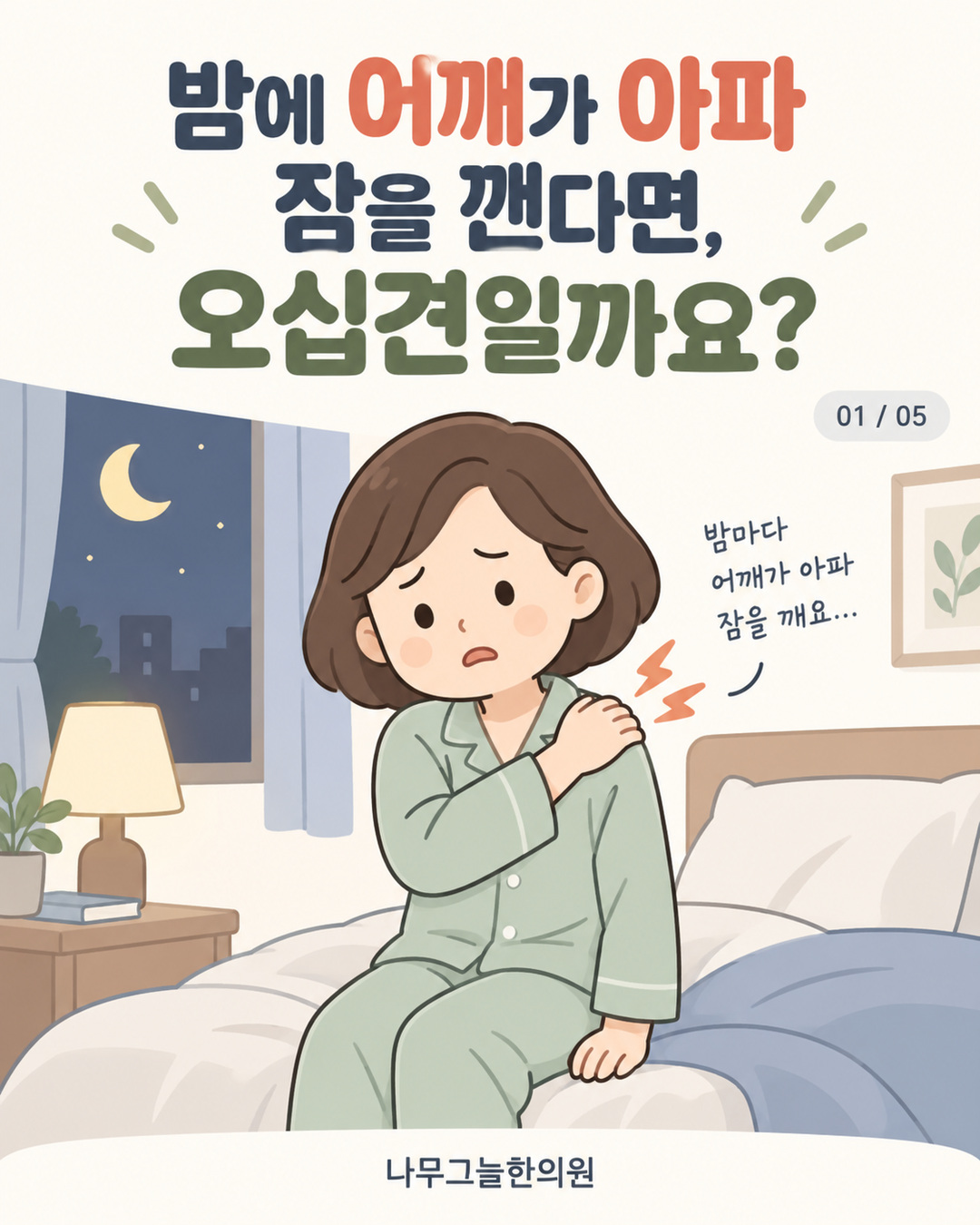
Night-time shoulder pain: frozen shoulder and Korean medicine care
Night-time shoulder pain: frozen shoulder and Korean medicine care
Shoulder pain at night does not always mean frozen shoulder. Increasing difficulty raising the arm or reaching behind the back calls for assessment of movement and other shoulder conditions.
Night pain also occurs with rotator cuff conditions. Assessment considers how symptoms began, range of motion and changes in strength. Frozen shoulder, or adhesive capsulitis, involves inflammation and tightening of the joint capsule, causing pain and restricted movement. Washing hair, dressing, reaching behind the back and turning the arm outward may become difficult.
The card contains Korean text. Please read the translated article below.
02
Adjusting sleep position and movement
Avoid pressure on the painful shoulder. When lying on your back, support the elbow and forearm with a thin cushion; when lying on the other side, rest the painful arm on a pillow in front. Move gently within a tolerable range during the day. Avoid forceful pulling through sharp pain, and adjust exercise to pain and stiffness.
03
Acupuncture and electroacupuncture
Systematic reviews of acupuncture for frozen shoulder reported improvements in pain, shoulder function and forward arm elevation. A review of electroacupuncture also reported positive pain and functional outcomes. Treatment is adjusted to the painful area and the response to movement.
04
Chuna and manual therapy
A Korean study applying shoulder-traction Chuna during Korean medicine treatment reported improvements in pain and movement in several directions. Chuna uses hands to work with joints and surrounding tissues. Overseas studies of mobilisation with movement, added to exercise or other care for frozen shoulder, reported improvements in pain, arm elevation and daily function. These findings inform consideration of manual therapies such as Chuna; the overseas technique studied was joint mobilisation.
05
Herbal medicine research
A 2019 review included 22 randomised trials of herbal medicine for frozen shoulder. Studies of Danggui Sini Tang reported improvements in pain and motion; Huangqi Duzhong Tang combined with manual therapy showed greater improvement in pain and shoulder function than manual therapy alone. A Japanese case series of 13 patients with longstanding frozen shoulder reported reduced pain after Nijutsuto (I-chul-tang) with exercise. Prescriptions consider symptoms, overall health and current medicines.
06
Clinical studies of bee venom acupuncture
In a randomised trial of 68 patients, one group receiving bee venom acupuncture with physiotherapy had better shoulder pain and disability scores at 8 and 12 weeks than saline injection with physiotherapy. Rest pain was better at 8 weeks and movement pain at 12 weeks. A one-year follow-up of 60 participants from the same trial found better pain/disability scores in one bee venom group and higher satisfaction in the bee venom groups.
Bee venom acupuncture is provided in a medical institution under clinical judgement. Bee venom can cause allergic reactions. Do not use live bees to sting yourself or inject bee venom at home or in a non-medical setting.
07
An individual treatment programme
Namugeuneul Korean Medicine Clinic in Anseong considers pain, movement and daily limitations when combining acupuncture, Chuna, herbal medicine, bee venom acupuncture and self-care into an individual programme. Exercise is adjusted to the response.
08
When to seek prompt assessment
Seek assessment for persistent pain or increasing stiffness. Prompt assessment is needed after an injury if you cannot raise the arm or suddenly lose strength, for a hot swollen shoulder with fever, or for progressive changes in arm sensation or strength.