Medical information · Musculoskeletal pain
Elbow pain in Anseong: does the outside hurt when lifting objects or wringing a cloth?
· 조영래
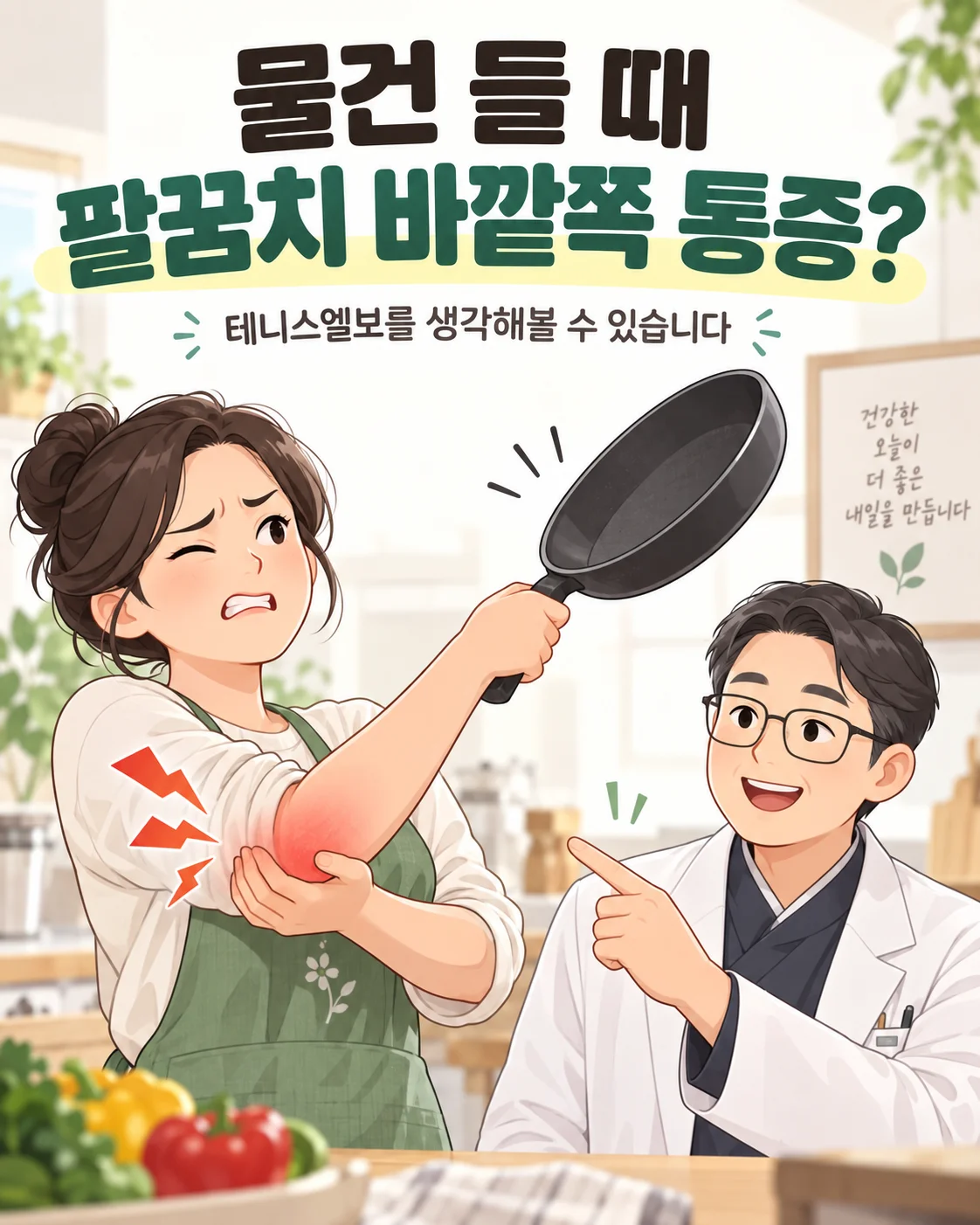
When lifting a frying pan or a heavy object, or tightly wringing a cloth, you may feel a sharp or aching pain on the outside of your elbow.
Because the elbow hurts, it is easy to assume the problem is in the elbow itself. In many cases, however, repeated strain has built up in the muscles and tendons that move the wrist and fingers.
These symptoms can occur with lateral epicondylitis, commonly called tennis elbow.
Despite its name, it does not affect only people who play tennis. It can also commonly occur in people who do a lot of housework or repeatedly use their hands at work.
Why does the elbow hurt when you use your hand?
Several muscles that extend the wrist or straighten the fingers originate at the outside of the elbow.
When you grip or lift an object, or repeatedly move your wrist, these muscles pull and continually transmit force to the tendons on the outside of the elbow.
At first, there may be only slight discomfort with a particular movement. Gradually, the pain may become more noticeable
- When lifting a cup or frying pan
- When turning a door handle
- When wringing a cloth or towel
- When gripping an object firmly
- When extending the wrist
during these movements.
However, not all pain on the outside of the elbow is tennis elbow.
It is important to consider how the pain began, its exact location, which movements provoke it, and whether there is also tingling or numbness in the hand or arm.
Reference: American Academy of Orthopaedic Surgeons — Tennis elbow
https://www.orthoinfo.org/diseases--conditions/tennis-elbow-lateral-epicondylitis/
It can develop even if you do not play tennis
“I do not even exercise. Why do I have tennis elbow?”
This is a question we sometimes hear in the clinic.
What matters is not whether you play tennis, but how repeatedly you have been using your hands and wrists.
Pain may begin after a sudden increase in housework, such as preparing holiday meals, repeatedly lifting heavy cooking utensils, or doing more twisting and gripping than usual.
The same applies when you frequently use screwdrivers or other tools at work, or repeatedly pick up and move objects.
If your elbow has recently started hurting, rather than thinking only “my elbow hurts,”
think about which repeated activities preceded it and what hurts the most.
It is worth recalling these details.
Reference: NHS — Tennis elbow
https://www.nhs.uk/conditions/tennis-elbow/
If lifting hurts, try changing the direction of your palm
Some people with pain on the outside of the elbow find it particularly painful to lift an object with the back of the hand facing upward.
If possible, try turning your hand so that your palm faces upward when you lift.
This can reduce the load on the wrist extensor muscles and may help ease pain on the outside of the elbow.
Start with a light object. For heavier objects, share the load between both hands rather than supporting it with one hand.
If it still hurts after changing your palm position, or rotating the forearm itself is uncomfortable, do not keep repeating the movement through pain.
Reference: Newcastle Hospitals — Tennis elbow self-care advice
https://www.newcastle-hospitals.nhs.uk/services/newcastle-occupational-health-service/information-for-staff/physiotherapy/self-help-leaflets/tennis-elbow/
If wringing a cloth hurts, reduce the twisting force
Wringing a cloth or towel places more strain on the elbow than you might think.
It combines a strong grip with twisting the wrists and forearms in opposite directions.
If wringing a cloth causes pain, it is therefore important to reduce both forceful twisting itself and how often you repeat it, rather than only changing the direction of your hands.
Instead of continuing a task for a long time, take breaks and divide painful tasks into smaller amounts.
Reference: NHS — Tennis elbow self-care advice
https://www.nhs.uk/conditions/tennis-elbow/
Pain does not mean you must stop moving your arm altogether
When elbow pain begins, some people ask whether they should avoid using the arm completely.
In most cases, it is best to reduce movements that cause significant pain while continuing gentle movement within a comfortable range.
You do not need to avoid all pain-free daily movement, such as slowly bending and straightening the elbow.
On the other hand, forceful stretching despite pain, or repeatedly doing wrist strengthening exercises through pain, is not advisable.
Exercise intensity should be adjusted to your current pain level and arm function.
Reference: NHS — Managing tennis elbow
https://www.nhs.uk/conditions/tennis-elbow/
Reference: American Academy of Orthopaedic Surgeons — Exercise programme
https://www.orthoinfo.org/en/recovery/epicondylitis-therapeutic-exercise-program/
Why do we often use bee venom therapy for tennis elbow?
At our clinic, we use bee venom therapy relatively often when treating tennis elbow.
Bee venom therapy is a type of pharmacopuncture using purified bee venom components.
Tennis elbow often involves pain arising from repeated strain where the wrist extensor muscles attach to the outside of the elbow.
During examination, pressing a particular area on the outside of the elbow may be especially painful, or pain may be reproduced when extending the wrist against resistance.
In such cases, after assessing the painful area and surrounding muscles, bee venom therapy can be applied to tender areas on the outside of the elbow and around the associated muscles and tendons.
In particular, when pain repeatedly occurs with gripping or lifting and there is clear tenderness on the outside of the elbow, we actively consider bee venom therapy alongside acupuncture.
Bee venom pharmacopuncture has been studied clinically for various types of musculoskeletal pain, including elbow pain, and studies evaluating pain reduction and functional improvement have been reported.
Reference: Systematic review of bee venom pharmacopuncture and musculoskeletal pain
https://pubmed.ncbi.nlm.nih.gov/40295986/
Reference: Clinical study of bee venom pharmacopuncture in patients with tennis elbow
https://pmc.ncbi.nlm.nih.gov/articles/PMC4332005/
With longstanding elbow pain, we also examine the shoulder and neck
People with longstanding tennis elbow may have not only elbow discomfort but also considerable stiffness in the wrist and forearm, or restricted movement of the shoulder and shoulder girdle.
The neck or shoulder may frequently ache and the whole arm may tire easily, or the posture used during work may be poor.
Especially when symptoms have recurred for a long time, it is helpful to assess movement throughout the wrist, forearm, elbow, shoulder and shoulder girdle rather than repeatedly treating only the elbow.
If needed, Chuna manual therapy may be used in these cases to address movement of the shoulder, shoulder girdle, neck and thoracic spine together.
Seek a clinical assessment in these situations
If there is no clear improvement after about two weeks of reducing arm use and trying self-care, it is advisable to have the condition assessed.
In particular,
- Pain so severe that even lifting a cup or a light object is difficult
- Pain that continues to interfere with work or housework
- Pain that disturbs sleep at night
- New tingling, numbness or reduced sensation in the hand or arm
- Severe pain and difficulty moving the arm after an injury
- Marked swelling or warmth around the elbow
should not be regarded simply as overuse.
Reference: NHS — Elbow and arm pain
https://www.nhs.uk/symptoms/elbow-and-arm-pain/
Visiting Namu Geuneul Clinic
370 Jungang-ro, Anseong-si, Gyeonggi-do
Hapyeong Place, 3rd floor, room 304
Consultation hours
Weekdays 9:00 a.m.–8:00 p.m.
Lunch break 1:00–2:00 p.m.
Saturday 9:00 a.m.–2:00 p.m.
No lunch break on Saturdays.
Closed on Sundays and public holidays.
Parking
The building's mechanical parking facility is available for passenger cars with an engine displacement of 2,000 cc or less.
Access may be restricted according to vehicle dimensions and specifications, and may be difficult after 5:00 p.m.
If building parking is unavailable or your vehicle exceeds 2,000 cc, please use Seokjeong-dong Public Parking.
Public parking address
7 Jungang-ro 367beon-gil, Anseong-si, Gyeonggi-do
Up to 90 minutes of free parking support
Consultation enquiries: 031-674-1075
Please call to confirm temporary closures or the day's registration closing time.
This article provides general health information. Actual diagnosis and treatment may vary according to symptoms and examination findings.