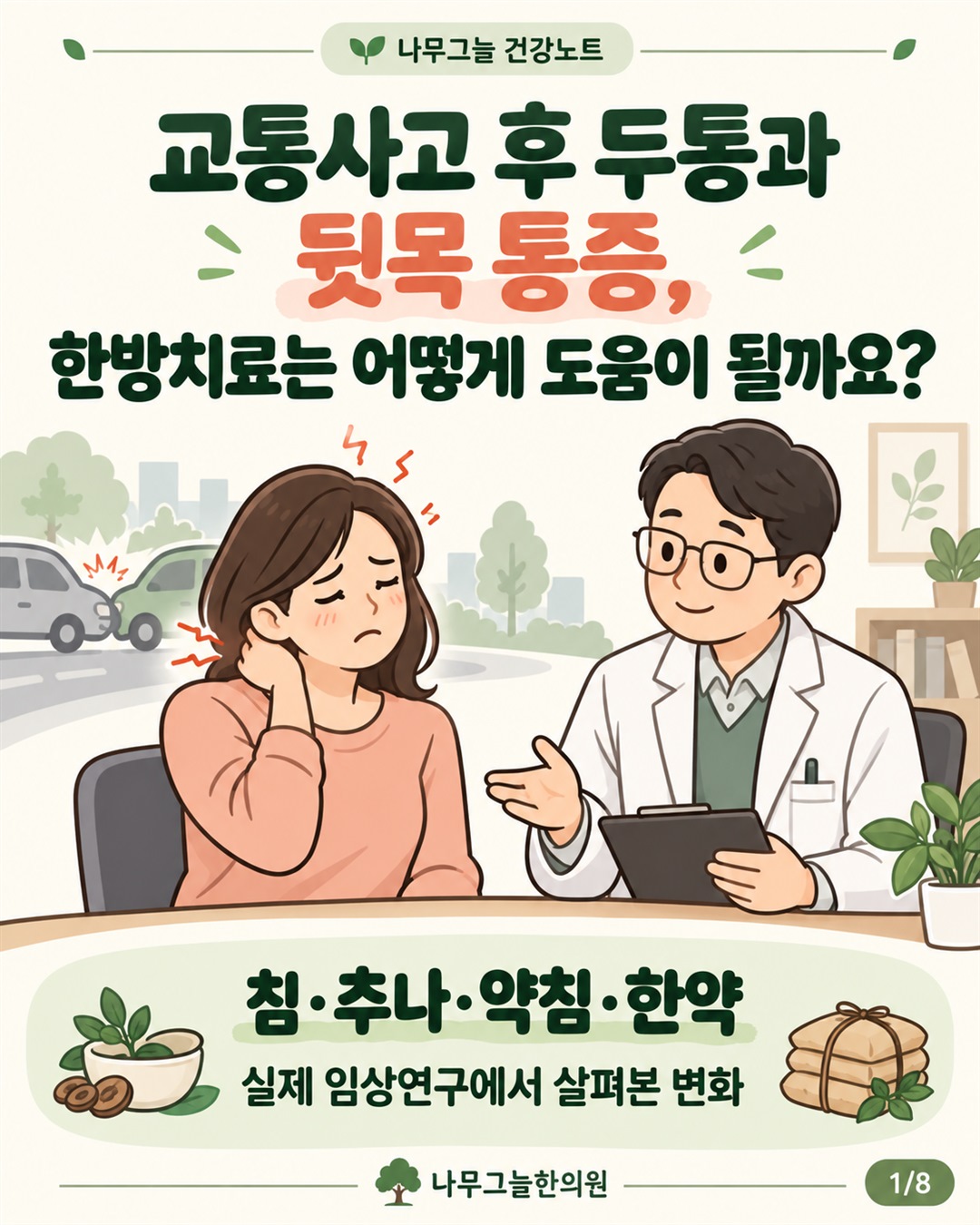
Headache and neck pain after a traffic accident: how can Korean medicine help?
Neck pain and headache can occur together after a traffic accident. Assessment considers the cause of the headache, neck movement, tenderness and accompanying symptoms. Clinical studies of acupuncture, Chuna, pharmacopuncture and herbal medicine have reported changes in pain and daily functioning. The treatments and combinations studied are described below.
Reduce daily strain rather than forcing the neck to loosen
Once serious injury has been assessed, continue everyday activities within tolerable limits rather than keeping the neck still for long periods or avoiding all movement. Break up time spent looking down at a phone or working at a monitor. Do not forcefully twist a painful neck or stretch through pain.
If concussion is diagnosed, rest for the first 1–2 days and then gradually increase light activity. Reduce the intensity if symptoms worsen. Discuss returning to driving and sport with your clinician.
The card contains Korean text. Please read the English explanation below.
02
Distinguish the causes of headache with neck pain
Sudden movement of the head and neck during a collision can cause neck pain, stiffness and headache. Assessment includes whether neck movement changes the headache and whether there is tenderness around the neck or back of the head.
Concussion can occur without a direct blow to the head. Dizziness, nausea, sensitivity to light or sound, or feeling dazed require assessment alongside neck symptoms rather than being attributed only to muscle tension.
Acupuncture is selected after assessing tenderness and neck movement. When the back of the neck feels tight and turning the head is difficult, treatment aims to reduce pain and improve everyday movement.
A pilot trial involving 40 people with whiplash found greater pain reduction after 2 weeks when acupuncture was added to usual care than with usual care alone. This is evidence concerning accompanying neck pain; neck pain and headache are followed together in clinical care.
Chuna techniques are selected according to the neck and surrounding tissues. Treatment after an accident does not necessarily involve forceful neck twisting.
In a randomized trial of 132 people with neck pain after a traffic accident, adding Chuna to usual Korean medicine care shortened the mean time to a 50% reduction in neck pain to about 23 days, compared with about 50 days in the comparison group.
A Korean comparative study of 38 people with cervicogenic headache after a traffic accident also reported greater improvements in pain and neck disability after 6 days in the group receiving Chuna in addition to basic care including acupuncture, herbal medicine and pharmacopuncture.
Pharmacopuncture: a study targeting the suboccipital muscles
The suboccipital muscles just below the back of the skull help support and move the head. When headache and posterior neck pain occur together, these muscles and areas of tenderness are assessed when considering pharmacopuncture.
A 2024 randomized trial divided 80 people with acute tension-type headache after a traffic accident into two groups. Both received acupuncture, general pharmacopuncture, Chuna and herbal medicine; one group also received 3 sessions of pharmacopuncture targeting the suboccipital muscles.
On day 4, the mean headache score was 2.84 in the additional-treatment group and 5.43 in the comparison group. Headache-related daily limitations also improved more. These results concern adding targeted suboccipital pharmacopuncture to combined treatment.
Herbal medicine: considering symptoms that accompany headache
Prescribing considers headache characteristics alongside sleep, digestion, tension, other pain and current medicines.
A Korean report described 3 people with headache after whiplash treated with Hwalhyeol-jitong-tang or Ansin-jitong-tang together with acupuncture, Shinbaro pharmacopuncture and Chuna. Their hospital stays were 7, 14 and 12 days respectively. Headache scores decreased from 6 to 1, 7 to 2 and 7 to 2, and the impact of headache on daily life also lessened.
These are reported improvements during combined treatment that included herbal medicine.
After an accident, a headache that keeps worsening and does not go away, repeated vomiting, reduced alertness or difficulty waking requires an immediate emergency department visit or a call to 119 in Korea. Slurred speech, new limb weakness and seizures are also emergency warning signs.
Namugeuneul Korean Medicine Clinic (나무그늘한의원), Room 304, 3rd floor, Hapyung Place, 370 Jungang-ro, Anseong-si, Gyeonggi-do. Tel. 031-674-1075.
Weekdays 09:00–20:00, lunch 13:00–14:00. Saturday 09:00–14:00 without a lunch break. Closed Sundays and public holidays.
The building's mechanical parking accommodates vehicles up to 2,000 cc; access may be difficult after 17:00. Up to 90 minutes of parking support is available at Seokjeong-dong public parking.