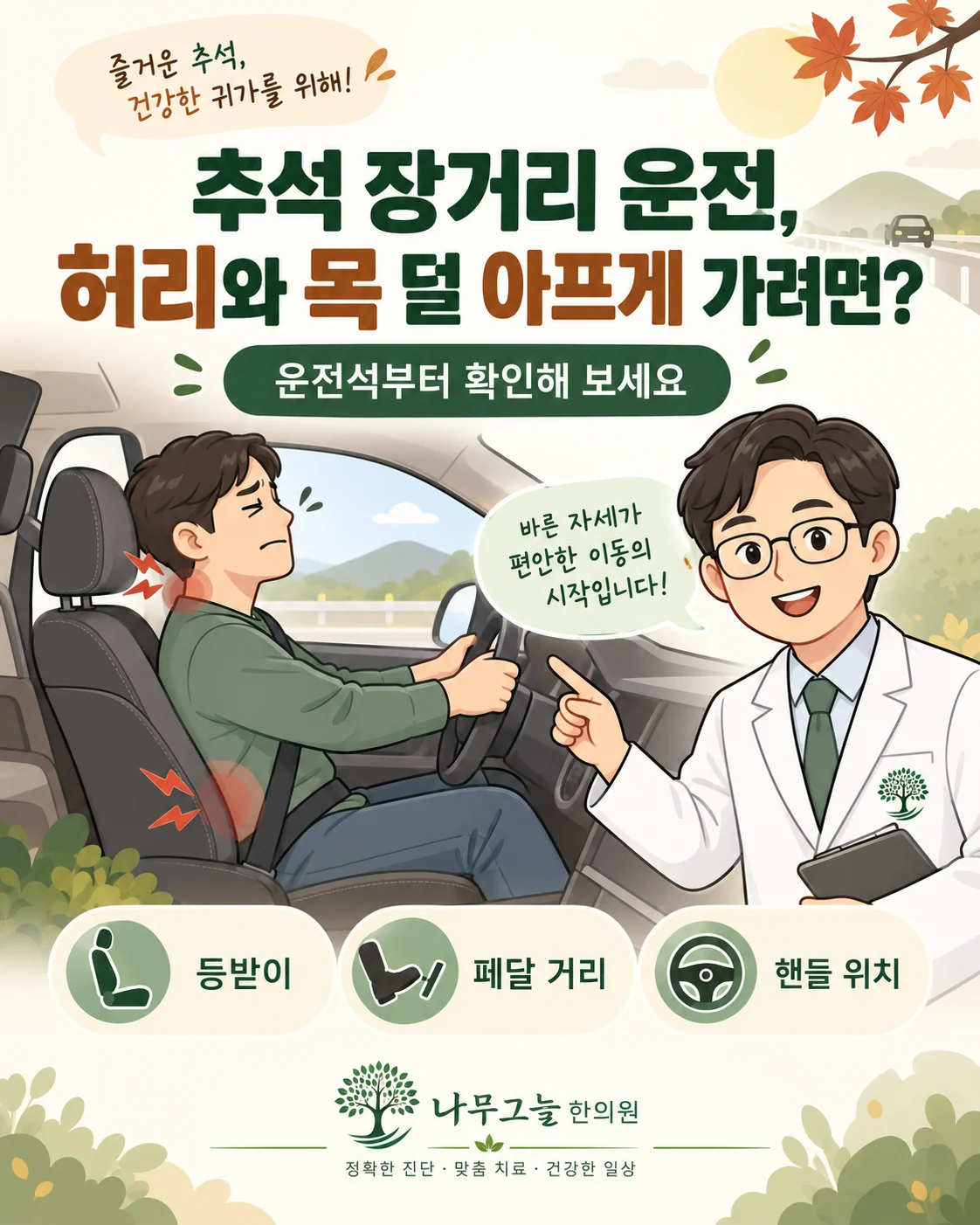
As Chuseok approaches, many people are planning to drive long distances.
It is easy to think that the pain in your back, neck, or shoulders after driving for a long time is simply due to “sitting for a long time.”
Of course, maintaining the same position for a long time can be a burden, but how the driver's seat is set can also have an impact.
If the backrest is too upright, the seat is too far from the pedals, or you have to keep reaching for the steering wheel, small strains will repeat for hours.
Before starting a long-distance drive, check everything from the backrest, pedals, steering wheel, lumbar cushion, and neckrest.
This is the original Korean guidance image. Please check the translated text of this page for details.
02
Is it better to keep the backrest upright at 90 degrees?
Some people place their backrest at almost 90 degrees because they think they need to protect their back. On the other hand, some people drive with the backrest reclined a lot in order to drive comfortably. It is difficult to say that either method is necessarily a good method.
Looking at studies on driver's posture and car seats, it is reasonable to start with a light tilt of about 100 to 110 degrees for the backrest and adjust it to suit body shape and vehicle structure.
But more important than the exact degree is your actual posture when sitting. Check out these three:
If you recline the backrest and your shoulders come off the backrest every time you grab the steering wheel, you may have reclined it too much.
Are your buttocks and back naturally touching the backrest?
Is your vision forward comfortable?
No need to lean forward to grab the steering wheel
03
What if your knees and ankles hurt after driving?
Also check the distance between the seat and pedals. If the seat is too close, your knees may be bent too much, and the strain around your knees, calves, and ankles may increase as your ankles continuously pedal in a narrow range.
Conversely, from a safety perspective, you need to be more careful if the seat is too far away. If your knees are almost fully extended when you apply the brakes deeply, performing emergency braking may be disadvantageous.
Even when you fully apply the brakes, it is best to find a position where your buttocks do not come off the seat and your knees are naturally slightly bent without being fully extended.
04
What if your shoulders and neck get tight even after driving a little?
When you hold the steering wheel, your elbows should naturally be slightly bent. Driving with your arms almost fully extended can cause your shoulders to shift forward and increase the strain around your neck and shoulders. When steering quickly, elbow movement margin may also be reduced.
In vehicles where the steering wheel can be adjusted back and forth, you can first adjust the seat to the pedals and then adjust the steering wheel position.
Also avoid being too close to the steering wheel. A general safety recommendation is to ensure a distance of approximately 25 cm or more between your breastbone and the center of the steering wheel. Please check in the following order.
1. Place your back and shoulders against the backrest.
2. Extend your arms forward.
3. Adjust so that your wrist touches the farthest part of the steering wheel.
4. Check whether your elbows are naturally bent when actually holding the steering wheel.
5. When turning the steering wheel left or right, your shoulders should not fall far from the backrest.
If the longer you drive, the more your back hurts, check out the back cushion.
Adequate lumbar support can help, but thicker cushions are not always better. If a cushion that is too thick pushes your lower back forward, your sitting posture and driver's seat setup may change.
The purpose of the lumbar cushion is not to force the lower back forward, but to naturally fill the space left between the backrest and the lower back.
If the vehicle itself has a lumbar support adjustment function, try using the original function first. After using the cushion, check to see if there are any of the following changes:
The pelvis may move forward on the seat.
Your back and shoulders may fall off the backrest.
The distance between the existing pedals and the steering wheel may change.
What if your head pushes forward when you use a neck cushion?
The basic car headrest and the separate neck cushion have different roles. The basic headrest is not a simple pillow, but a safety device designed in conjunction with the seat to reduce the difference in head and torso movement during a rear collision.
If the back of the head is pushed forward or the chin is brought forward due to the separate thick neck cushion, or if the positional relationship between the original headrest and the head changes significantly, it should be used with caution.
Not all neck cushions are dangerous, but feeling comfortable and being safe in a crash are not the same thing.
The appropriate setting varies depending on the vehicle structure, height, and arm and leg length. Rather than using one number as an absolute standard, check the following five things from your actual sitting position.
1. Are your buttocks and back well supported by the seat and backrest?
2. Is the backrest neither too upright nor too reclined?
3. Do your knees remain slightly bent when you press the brake deeply?
4. Are your elbows naturally bent when holding the steering wheel?
5. Are you sitting without a lumbar or neck cushion pushing your body forward?
08
No matter how well you sit, if you drive in the same position for a long time, you will get tired.
Even if you fit the driver's seat well, maintaining the same position for a long time can cause fatigue. Take a break in between to change your posture and move your body.
At a rest stop, rather than starting with strong stretching as soon as you get out of the car, walk naturally for a few minutes and then lightly move your back, hips, and shoulders.
Do not force yourself to bend or twist strongly while in pain.
If you experience these symptoms after driving, don't just treat them as fatigue.
If you have the following symptoms, do not assume it is just driving fatigue, but see a doctor to check for possible movement and neurological abnormalities.
Pain or numbness extending from the buttocks to the thighs and calves
Numbness extending from the neck down to the arms and hands
Feeling weak in your arms or legs
sensory changes
Pain that gets worse over time
If there is no clear improvement even after a few days
10
Related medical information
Please check clinic hours, location, and parking information before visiting.
This article is general health information and does not replace an individual diagnosis. Appropriate posture and treatment details may vary depending on vehicle structure, body type, and current symptoms.